
Smuggling balloons land near MP's home in Trakai, Lithuania
Two smuggling balloons carrying contraband cigarettes came down near a lake in Trakai district early on the morning of May 19, 2026, a few houses from Lithuanian MP Edita Rudelienė's home.
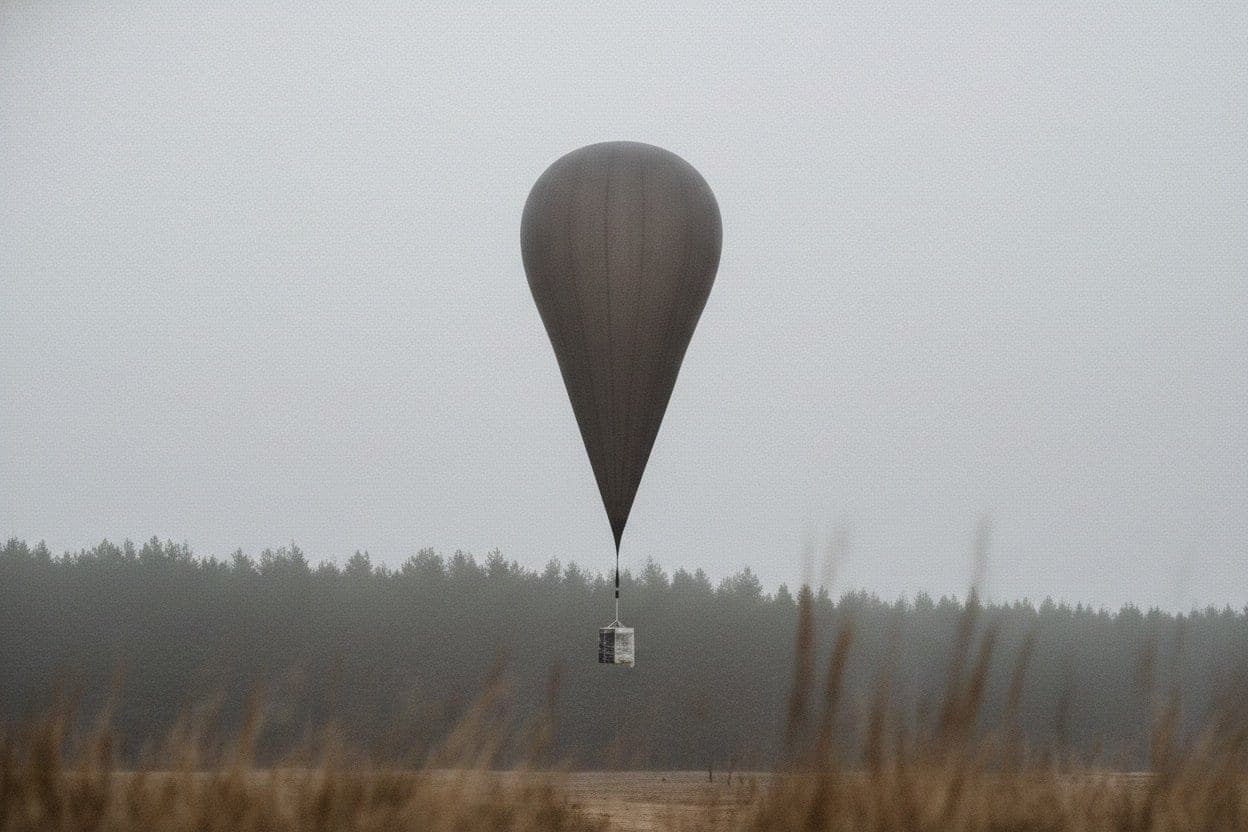
Two smuggling balloons carrying suspected contraband cigarettes came down by a lake in Lithuania's Trakai district early on the morning of Tuesday, May 19, 2026, about five houses from the home of Liberal Movement MP Edita Rudelienė. Trakai is about 46 km in a straight line from the nearest point of the Belarusian border, by AirVeto's measurement: about 80 minutes of drift at that night's 34 km/h.
Rudelienė told 15min she saw the balloons at about 5:30, when she went to the lake for her morning swim, and that officers arrived within about five minutes of her call. Vilnius County Police also logged a call at 05:48 from a resident, and two more reports later.
Officers found two meteorological balloons with boxes attached, carrying suspected contraband cigarettes. Police spokesperson Julija Samorokovskaja told 15min they were handed to the border guards, who investigate such cases. The number of packs was not reported.
The exact village and lake were not published. This page is centred on Trakai, the district seat, about 23 km west of central Vilnius by AirVeto's measurement. The marker shows the district, not the landing point.
A landing well inland
The nearest stretch of the Lithuanian–Belarusian border lies south-east of Trakai. A balloon from Belarus that landed here had to cross that border and travel tens of kilometres beyond it. The Kaunas Šančiai recovery of May 13, six days earlier, was another deep inland landing.
Two days before, on Sunday May 17, smuggling balloons caught on power lines in Uoginiai, Kupiškis district, LRT reported.
The wind that night
AirVeto's wind data at 3,000 m for 00:00 UTC on May 19 shows the air over Trakai coming from the south-southeast (165°) at 34 km/h. Across the surrounding grid it came from between 142° and 246°, at 18–50 km/h, so the flow was not uniform.
| Wind parameter | Value |
|---|---|
| Altitude | 3,000 m |
| Time | 00:00 UTC, May 19, 2026 |
| Direction (from), Trakai grid point | 165° - south-southeast |
| Speed, Trakai grid point | 34 km/h |
| Direction range (from), surrounding grid | 142°–246° |
| Speed range, surrounding grid | 18–50 km/h |
| Source | Open-Meteo historical-forecast-api |
At the grid-point speed, the 46 km from the border takes about 80 minutes. Across the grid's speed range it takes about 55 to 150 minutes. That is a straight-line minimum, not a tracked flight: the launch point, altitude and landing time were not published. Rudelienė saw the balloons at about 5:30 local time (02:30 UTC).
How AirVeto models the wind at this altitude, and its known limits, is on the methodology page. This reconstruction draws on reporting by LRT, 15min.lt and lrytas.lt, and on AirVeto's wind data for the night of May 19, 2026. All Lithuanian smuggling-balloon incidents are collected at Kontrabandos balionai.
Related location
- Suwałki Gap - The 65 km land strip linking Poland to Lithuania - and the EU's only land connection to the Baltic states.
- NATO eastern flank - The frontier where EU airspace meets Russia and Belarus across five NATO member states - the active zone of drone incursions, smuggling balloon recoveries, and Baltic Air Policing intercepts since 2025.
Sources
- LRT - Netikėtas radinys: maudynių ežere atvykusi Seimo narė rado kontrabandinius balionus (May 19, 2026)
- 15min.lt - Prie Seimo narės Editos Rudelienės namų nusileido kontrabandininkų balionai (May 19, 2026)
- lrytas.lt - Kontrabandiniai oro balionai toliau skrenda į Lietuvą: kontrabandininkų siunta nusileido Trakų rajone (May 19, 2026)
- Methodology
Last updated: