
Belarus balloon carries 9,000 cigarettes into Kaunas, Lithuania
A balloon carrying ~9,000 cigarette packs landed in Šančiai, Kaunas, on May 13, 2026; the ICON wind field shows a sustained flow pushing north from the Hrodna (Grodno) oblast of Belarus.
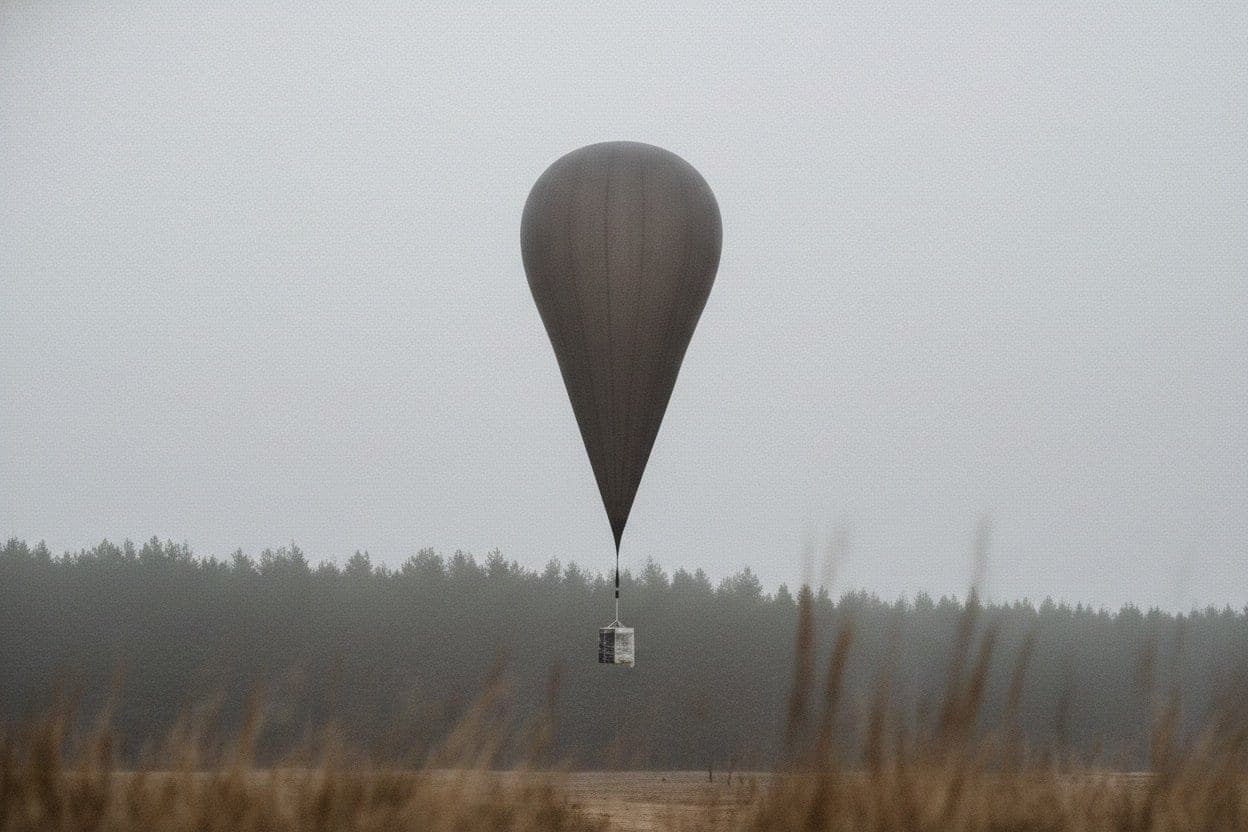
At approximately 03:17 local time on May 13, 2026 (00:17 UTC), a meteorological-style smuggling balloon landed on Lauryno Ivinskio Street in the Šančiai district of Kaunas, carrying six boxes containing approximately 9,000 packs of contraband cigarettes of Belarusian origin. Lithuanian Police Department spokesperson Ramūnas Matonis confirmed the recovery to ELTA on Wednesday morning; no suspects were on scene at the time of discovery, and the case was forwarded to the State Border Guard Service (VSAT) to be folded into its ongoing balloon-smuggling investigations.
The recovery is notable for its depth inland. Kaunas sits roughly 100–130 km north of the nearest Belarusian territory at this longitude, with the closest border points around Druskininkai and the LT/PL/BY trijunction near Lazdijai, both well south of Kaunas, and well beyond the typical Druskininkai / Varėna / Vilnius approach zone where the bulk of 2026 recoveries have clustered. To AirVeto's knowledge this is only the second confirmed contraband-balloon landing inside Kaunas city itself, the first being the July 2025 recovery near the Viktoras Kuprevičius progymnasium.
AirVeto's wind reconstruction places the Šančiai balloon's release point in the Hrodna (Grodno) oblast of southwestern Belarus, based on the ICON wind field at 3,000 m at 23:00 UTC on May 12, 2026 - a uniform flow pushing north at 28–29 km/h across the full Lithuanian grid, consistent with a ~130 km south-to-north transit in approximately 5 hours.
The Vilnius Airport airspace restriction ran concurrently
The Šančiai landing happened within the same operational window as a temporary airspace restriction over Vilnius International Airport:
- 02:16 local (23:16 UTC, 12 May): Lithuanian Airports (LTOU) imposed airspace restrictions over EYVI after navigation signatures consistent with balloons were detected in flight zones.
- 03:16 local (00:16 UTC, 13 May): restrictions lifted, airport operations resumed.
- 03:17 local (00:17 UTC, 13 May): the Kaunas balloon was reported on the ground in Šančiai - one minute after Vilnius reopened.
The Vilnius closure affected two flights and around 128 passengers: one aircraft was diverted to Copenhagen, one flight was cancelled. Whether the Šančiai balloon was among the objects that triggered the Vilnius restriction, or part of a separate cluster, has not been publicly attributed.
The ICON wind field on the night of 12–13 May placed the release point in Hrodna oblast
The ICON icon_eu + best_match wind field at 3,000 m across a 5×5 grid centred on Kaunas at 23:00 UTC on May 12, 2026 showed a uniform pattern pushing north across the entire Lithuanian airspace:
- All 25 grid cells reported wind FROM the southern half of the compass (158°–203°, median 172°)
- Centre cell (Kaunas): 28.7 km/h from S
- Grid mean: 27.3 km/h from S
- Flow direction: consistently toward the north / north-northwest across the entire grid
- AirVeto live map cross-check at 2 km: ~19 km/h flow toward NNW near Kaunas at 03:00 local on 13 May
The Kaunas centre cell sustained 22–29 km/h from the SSE/S throughout the release-to-landing window (18:00–23:00 UTC on 12 May), with the source direction backing slowly from SSE at 18:00 UTC toward S by 23:00 UTC.
What this means for the release point
A pure northward drift pattern relocates the most plausible release point south of Kaunas, not east of it. At Kaunas's longitude (~23.9°E), the closest Belarusian territory directly south is the Hrodna (Grodno) oblast, with the city of Hrodna sitting at 53.68°N, 23.83°E - approximately 130 km due south of Kaunas, on the observed wind axis.
At a 25 km/h mean drift speed at 2–3 km altitude, the 130 km south-to-north transit takes ~5 hours, putting the most plausible release window between 19:00 and 20:00 UTC on 12 May for the 00:17 UTC landing on 13 May. The smuggling-balloon cruise band of 2,000–3,000 m is well-supported by the wind profile here: at both altitudes the AirVeto rendering and the historical-forecast pull agree on a sustained flow pushing north throughout the night.
This is not the east-to-west envelope typical of the Druskininkai / Vilnius approach-zone recoveries that have dominated late-2025 / early-2026 reporting. It is a south-to-north transit out of southwestern Belarus, which is operationally distinct: it implies releases from the Hrodna area specifically, not the eastern frontier across from Vilnius.
Co-timing with the Vilnius restriction
Both the Vilnius Airport airspace restriction (23:16 UTC on 12 May to 00:16 UTC on 13 May) and the Šančiai landing (00:17 UTC on 13 May) are downstream of the same overnight wind regime. Whether the Vilnius detection and the Kaunas balloon came from the same release cluster or independent ones is not publicly attributed, but the wind field makes a same-origin cluster geometrically plausible: a release fan out of the Hrodna area on the observed northward-pushing flow would spread northward across both the Vilnius approach (~100 km NE of Hrodna) and the Kaunas approach (~130 km N of Hrodna) within compatible time windows.
Lithuanian authorities intercepted 134 balloons in the six months preceding the landing
Per the Lithuanian Police Department, since November 24, 2025, when joint police, VSAT, Customs Criminal Service, and Military Police raids in border districts began, 134 balloons carrying contraband cigarettes have been detected, with 376,000+ packs of Belarusian-origin cigarettes recovered, 72 individuals detained, and 19 pre-trial investigations opened.
VSAT spokesperson Giedrius Mišutis told ELTA that the 2026 monthly counts are running below the 2025 levels (April 2026: 7 balloons intercepted vs April 2025: 46; March 2026: 30 vs March 2025: 77; February 2026: 24 vs February 2025: 45) - but the Kaunas landing illustrates that fewer balloons does not mean shorter range: individual objects are still capable of reaching well past the border zone given favourable upper-level winds.
The Šančiai landing illustrates what AirVeto’s view is for: a wide, uniform flow pushing north across the whole country, sustained long enough to put a balloon released 130 km away into a residential street in Kaunas. The map shows the drift path; the recovery confirms where the drift path delivered. This reconstruction draws on reporting by LRT, 15min.lt, and Kauno diena, and on AirVeto's wind-model analysis of the ICON wind field at 3,000 m for the overnight window of May 12–13, 2026.
The Kaunas landing is one entry in the wider contraband-balloon campaign along the Belarusian frontier - see the 19 May Trakai-district recovery, another deep-inland landing, and the full incident archive. How AirVeto models the wind field that carried this balloon, and its known limits, is documented on the methodology page. Every Lithuanian balloon incident is collected at the category landing: Kontrabandos balionai.
Related location
- Suwałki Gap - The 65 km land strip linking Poland to Lithuania - and the EU's only land connection to the Baltic states.
- NATO eastern flank - The frontier where EU airspace meets Russia and Belarus across five NATO member states - the active zone of drone incursions, smuggling balloon recoveries, and Baltic Air Policing intercepts since 2025.
Sources
- LRT - Naktį Kaune nusileido kontrabandininkų balionas su 6 dėžėmis baltarusiškų cigarečių (May 13, 2026)
- 15min.lt - Kaune praėjusią naktį nusileido kontrabandininkų balionas su 9 tūkst. pakelių cigarečių (May 13, 2026)
- Kauno diena - Naktį Šančiuose – neeilinis sujudimas (May 13, 2026)
- Lithuanian Police Department - spokesperson Ramūnas Matonis (ELTA)
- Methodology
Last updated: