
Two smuggling balloons land on Šventoji coast, Lithuania
A twin-envelope balloon crossed Lithuania east to west at 1–3 km altitude on January 31, 2026, arriving over Šventoji on the Baltic coast at around 09:00 local time.
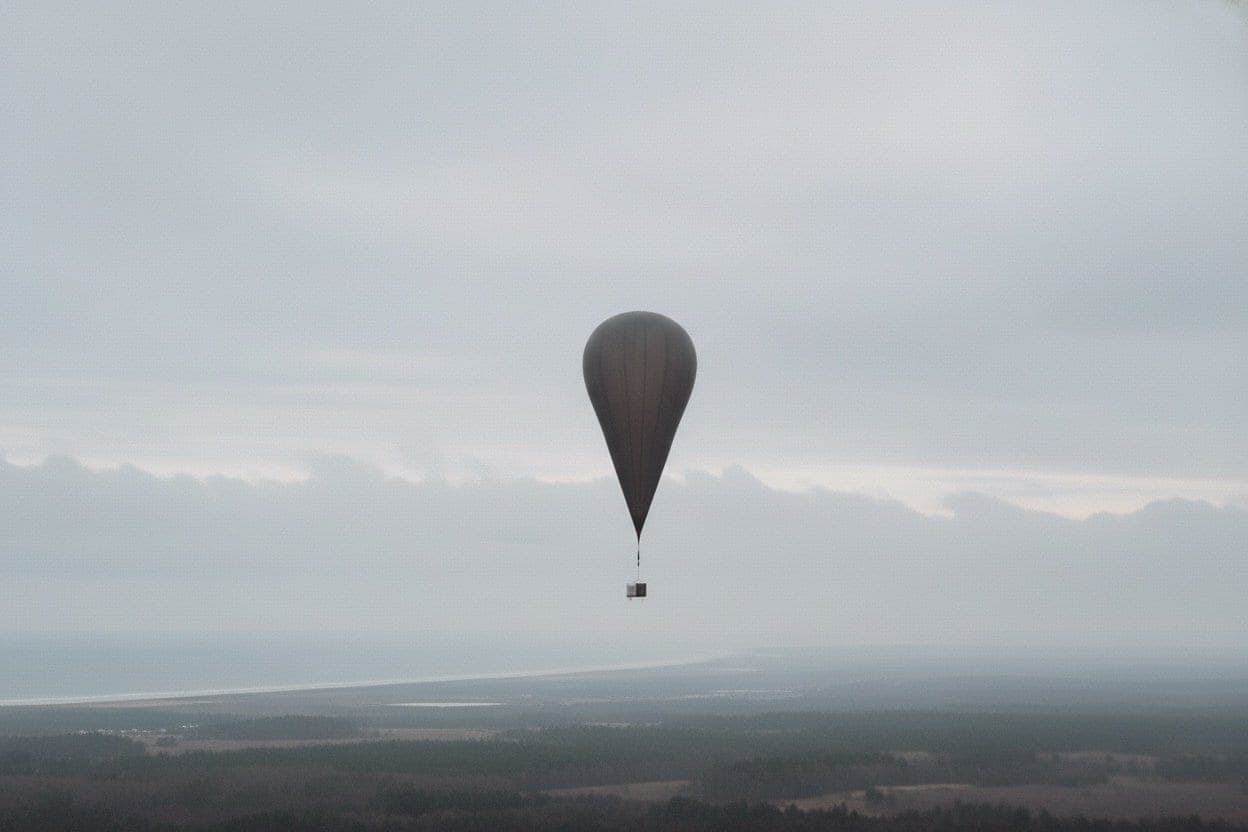
Around 09:00 local time on January 31, 2026 (07:00 UTC), a twin-envelope contraband-smuggling balloon, a paired-balloon design built to carry a cigarette payload and then gradually leak helium and descend, was photographed over the Šventoji coast on the Lithuanian Baltic seaboard, at the western edge of the country. It had crossed the full east-west extent of Lithuania at roughly 1–3 km altitude; coastal photographer Čepulio fotoklajonės, who filmed the object, estimated a ground speed of approximately 30 km/h. The contraption appears to have malfunctioned: by design such paired envelopes are meant to descend and land over Lithuanian territory; this one instead continued drifting toward the coast. AirVeto's reconstruction of the ICON wind field at 2,000 m at 05:00 UTC on January 31, 2026 shows E flow pushing west (grid centre 100°, range 71°–117°) at 37–58 km/h across Lithuania - the east-to-west direction is consistent with the observed crossing, though the modeled wind speed is notably faster than the estimated ground speed (see wind section below).
Footage of the object over the coast was captured by local photographer Čepulio fotoklajonės on the morning of 31 January.
Wind conditions across the Lithuania transit zone on 31 January
AirVeto’s ICON wind field at 2,000 m at 05:00 UTC on January 31, 2026 showed sustained east-to-west flow at 37–58 km/h (mean 50 km/h) across central and western Lithuania, with the Lithuanian-Belarusian border segments orange (inside the 85° inflow threshold) throughout the preceding night. The direction - a consistent 71°–117° E band, centred around 100° - is the wind direction that carries anything aloft from Belarus across the full east-west extent of Lithuania toward the Baltic coast.
The modeled wind speed (37–58 km/h at 2,000 m) is notably faster than the photographer’s ~30 km/h ground-speed estimate. Possible explanations: the balloon operated partly in the lighter boundary layer below 2,000 m during sections of the transit, which would reduce effective ground speed; or the visual speed estimate over featureless terrain was imprecise. At 37 km/h - the slowest point in the grid - the ~400 km east-west extent of Lithuania would take roughly 11 hours, consistent with a pre-dawn launch on the Belarusian side for a 09:00 local coast arrival. At the modeled mean of 50 km/h, the transit time compresses to ~8 hours.
The east-to-west flow holds at all three relevant altitude bands
- 500 m: boundary-layer wind was lighter and more variable - the lower boundary layer is where ground-speed estimates from visual observation are most likely to be accurate, and where a slower effective speed (~30 km/h) is physically plausible.
- 2,000 m: east-to-west flow at 37–58 km/h - the east-to-west direction is confirmed; the speed is faster than the estimated ground speed.
- 5,000 m: still pushing west but stronger still; would have crossed the country faster than was observed.
The direction of transit is consistent across all three levels. The speed uncertainty is real: the photographer’s ~30 km/h estimate is a visual observation, not an instrument measurement, and the boundary-layer explanation is plausible. What is not in question is that AirVeto’s January E-flow field placed Lithuania in a sustained east-to-west drift path that morning - the object’s observed path from the Belarusian side to the Baltic coast follows that drift path.
The model behind that rendered field, and the limits on where it can be trusted, is documented on the methodology page.
This reconstruction draws on reporting by LRT and on footage from coastal photographer Čepulio fotoklajonės, and on AirVeto's ICON wind-model data for the 05:00 UTC window on January 31, 2026.
The same east-to-west January flow that pushed this contraption to the coast also fed that winter's Lithuanian-Belarusian border recoveries - among them the 28 January Vilnius Airport incursion and the 6 February Druskininkai seven-balloon day. The full set is indexed under incident archive. Every Lithuanian smuggling-balloon incident, with wind reconstruction, is collected at Kontrabandos balionai.
Related location
- NATO eastern flank - The frontier where EU airspace meets Russia and Belarus across five NATO member states - the active zone of drone incursions, smuggling balloon recoveries, and Baltic Air Policing intercepts since 2025.
Sources
Last updated: