
NATO jets shoot down drone over Balvi - Latvia's second intercept
On August 14, 2026, NATO jets shot down a foreign drone over Latvia's Balvi region after Russian electronic warfare diverted it into NATO airspace - Latvia's second aerial intercept in two months.
Latvia's National Armed Forces (NBS) confirmed that NATO fighter jets shot down a foreign unmanned aerial vehicle over the Balvi region in northeastern Latvia in the early hours of August 14, 2026, after Russian electronic warfare diverted it into Latvian airspace. According to LRT, an orange airspace alert was issued for the Augšdaugava, Preiļi, Rēzekne, Balvi, and Alūksne municipalities shortly before 04:00 local time (00:55 UTC); jets scrambled from Šiauliai Air Base in Lithuania identified and destroyed the object within minutes of making contact, and the alert was lifted about an hour later. This was Latvia's second confirmed aerial intercept of a foreign drone, after the 8 June Nautrēni interception. AirVeto's wind layer for the 00:55-02:00 UTC window over northeastern Latgale is in the map above.
The alert covered five municipalities for about an hour
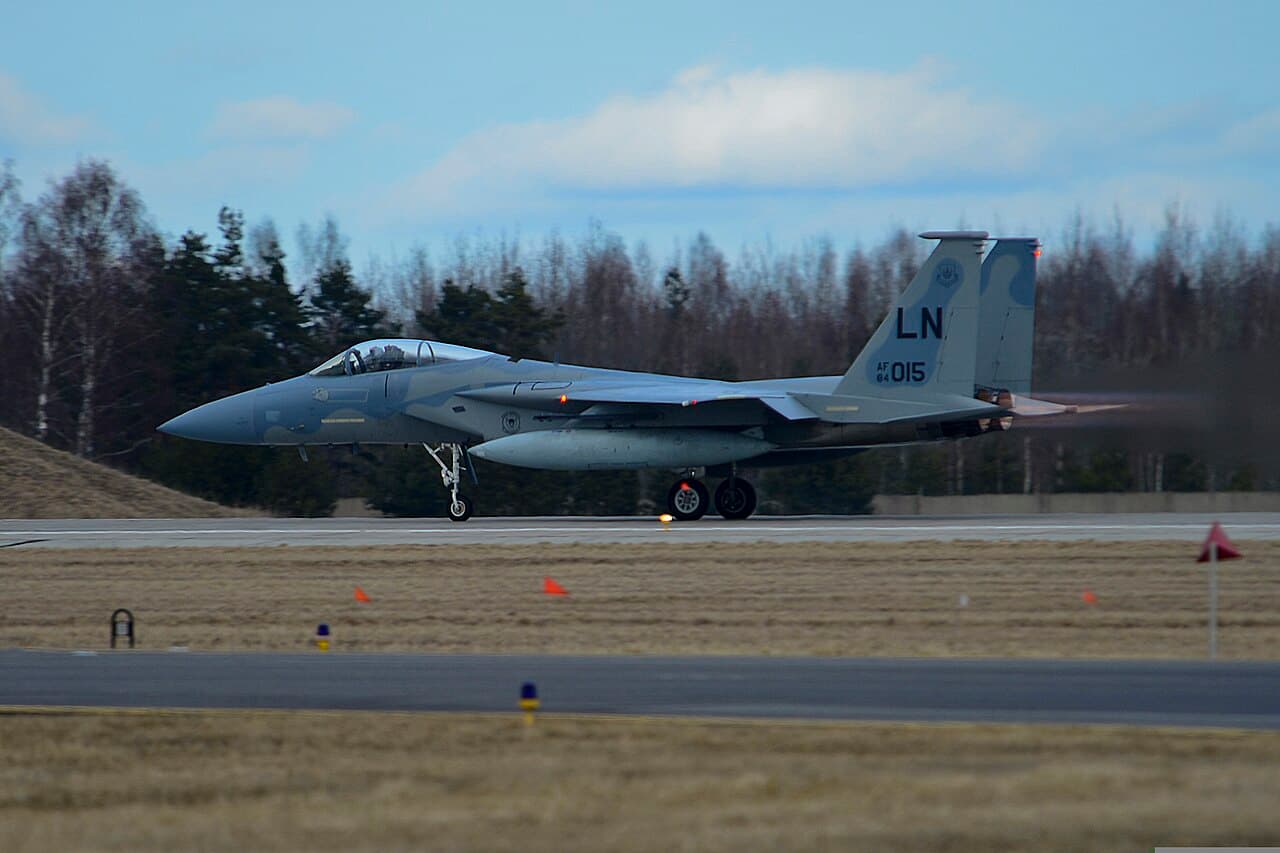
Latvia's NBS issued an orange airspace alert shortly before 04:00 local time (00:55 UTC), covering Augšdaugava, Preiļi, Rēzekne, Balvi, and Alūksne municipalities. Residents in the affected area received mobile-phone warnings urging immediate precautions. NATO Air Command said two Italian Eurofighters scrambled from Šiauliai Air Base in Lithuania and two Turkish F-16s from Ämari Air Base in Estonia to identify and intercept the object; one of the Italian Eurofighters "neutralised the potential threat over an unpopulated area." The alert was lifted at 04:50 local time (01:50 UTC).
NATO allies had already met earlier in the week to discuss the pattern of eastern-flank drone incursions, and issued a statement of "full solidarity with and support for the affected Allies," placing responsibility on Russia. Latvia's military said it has deployed additional air-defence units to the country's eastern border and expects further incidents "as long as Russia's aggression in Ukraine continues."
Russian electronic warfare is the stated cause
Iveta Bērziņa, a spokeswoman for the Latvian armed forces' Joint Headquarters, said the object's exact path into populated areas before interception could not yet be confirmed. Vilmantas Vitkauskas, chief of Lithuania's National Crisis Management Centre, told LRT TV the object most likely changed course over Russian territory, or crossed into NATO airspace from Belarus or Russia - which of the two was still being determined.
Vitkauskas described the mechanism as consistent with a pattern seen since March 2026: Ukrainian long-range drones launched against Russian infrastructure near Russia's Leningrad region have their navigation jammed or spoofed by Russian electronic-warfare systems on approach, deflecting them off course and, on occasion, into Baltic NATO airspace instead of their intended target. Lithuanian Defence Minister Robertas Kaunas said the drone's precise origin remained to be determined. AeroTime reported that Leningrad region governor Alexander Drozdenko separately claimed Russian forces shot down fifteen drones elsewhere in the region overnight - a claim reported via AeroTime, not independently verified.
No damage was reported. A search operation for wreckage was underway as of Friday morning. Finland, as it has done in comparable incidents, temporarily restricted air and maritime traffic in the eastern Gulf of Finland as a precaution; the Finnish Defence Forces said no drone entered Finnish territory and lifted the restriction shortly after 07:00 local time. Estonian authorities tracked the object and shared information with Latvia and Lithuania throughout.
Latvia's second intercept in two months
The 8 June Nautrēni interception was Latvia's first shoot-down of a foreign drone on its own territory, coming a month after NBS commanders had declined to engage three drones over Rēzekne and Viļāni on safety grounds. The 19 May shoot-down over Kablaküla, Estonia, was the first NATO fighter intercept of a drone over Baltic airspace, though the object had first crossed Latvian territory. Friday's Balvi intercept is Latvia's second engagement of a foreign drone on its own soil in two months, following the same Russian-EW-diversion mechanism attributed to both prior cases.
Latvia has also been examining lower-cost ways to counter the recurring threat. AeroTime reported the country is considering acquiring Embraer A-29 Super Tucano turboprop aircraft, intended as a cheaper option than scrambling frontline NATO fighters for slow-moving drones.
This reconstruction draws on reporting by LRT, AeroTime, LSM English, Bloomberg, France 24, Euronews, and CNBC, and on AirVeto's wind-model data for the 00:55-01:50 UTC window over northeastern Latgale on August 14, 2026. At 01:00 UTC, close to the moment of interception, the 1,000 m layer over Balvi showed NW wind at 16.6 km/h. At 2,000 m the wind was also NW, at 33.8 km/h; at 3,000 m it shifted to NNW at 55.5 km/h. How the model is built and where it is reliable is on the methodology page.
The 14 August intercept is the latest in the 2026 series of drone incursions into Baltic NATO airspace. For the broader pattern, see the 8 June Nautrēni interception, the 19 May Estonia drone shootdown, and the 2-3 June Estonia and Latvia drone alerts.
Sources
- LRT - NATO fighter jets shoot down drone over eastern Latvia (14 Aug 2026)
- AeroTime - NATO fighters shoot down drone in Latvia as Finland restricts airspace (14 Aug 2026)
- LSM English - NATO fighters shoot down drone in north-east Latvia (14 Aug 2026)
- Bloomberg - NATO Jets Shot Down Drone That Entered Latvian Airspace (14 Aug 2026)
- France 24 - NATO jets shoot down drone flying over eastern Latvia (14 Aug 2026)
- Euronews - NATO Baltic Air Policing jets shoot down drone over Latvia (14 Aug 2026)
- CNBC - NATO aircraft shoot down drone over Latvia, which blames 'Russian electromagnetic warfare' (14 Aug 2026)
- Methodology