
Latvia's Belarus border closure exposes an infrastructure gap
Belarus redirected migrant pressure onto Latvia's border in 2026. Two unfinished infrastructure layers explain the strain: surveillance and rail.
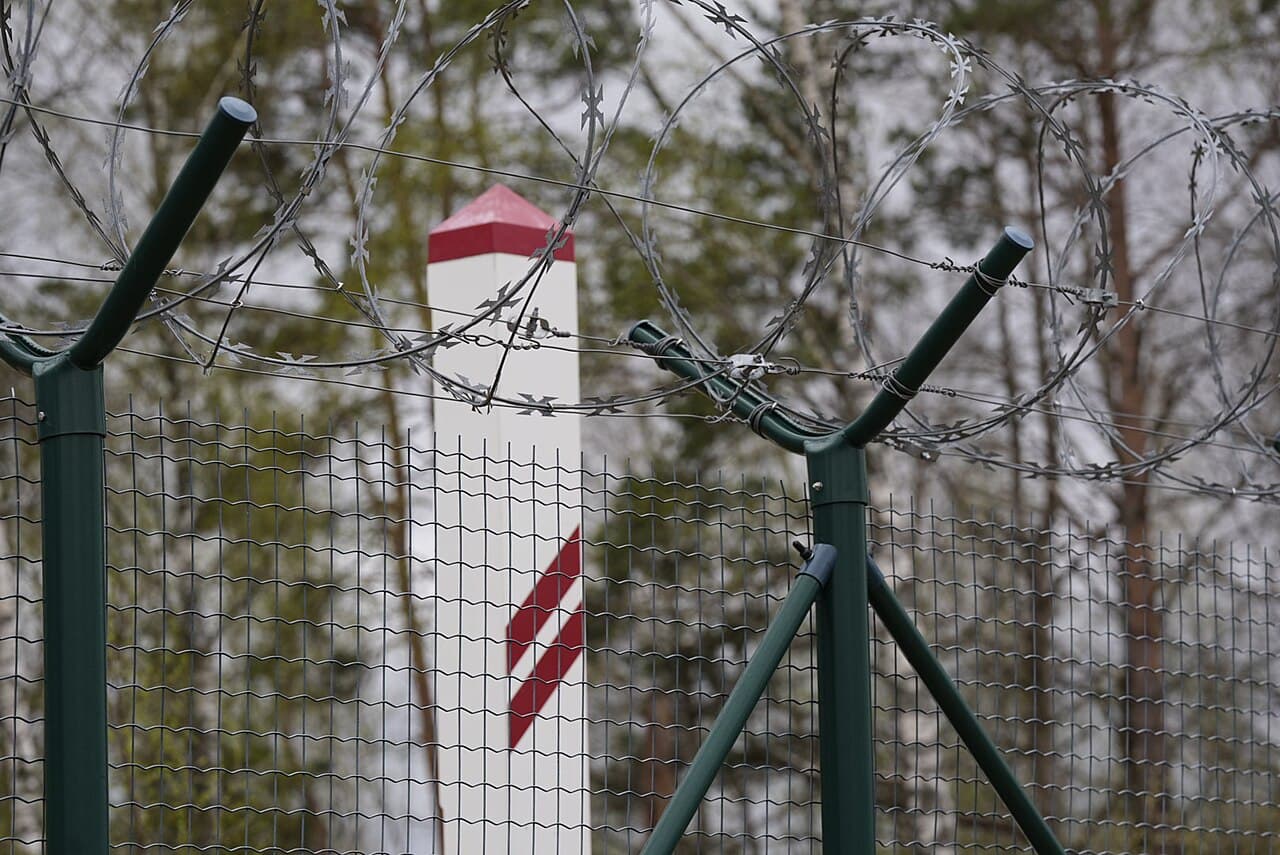
On July 31, 2026, Latvia closed Pāternieki, its only open crossing with Belarus. Interior Minister Jānis Dombrava attributed the closure to a malfunction in the checkpoint's information systems (LRT). The closure sits inside a larger shift: Belarus has redirected most of its migrant-pressure campaign from the Lithuania-Belarus border onto the Latvia-Belarus border since mid-2026, and the Baltic states' mutual-aid system has moved with it. Lithuania and Estonia have both sent border guards to help, and Estonia's role has grown the fastest.
Latvia now absorbs nearly all of the region's Belarus-directed crossings
Latvia recorded 111 attempted illegal crossings from Belarus in a single day on July 17, 2026. Lithuania, whose Belarus border runs four times longer, recorded two attempts the same day. Poland recorded zero the day before.
OSW Centre for Eastern Studies data shows the pattern holds across the full year, not just one snapshot. Latvia's border guard prevented 12,046 illegal crossings in all of 2025. By mid-July 2026 the count already stood at roughly 8,000, with around 1,000 stopped in the first two weeks of July alone.
Lithuania recorded 905 attempts and Poland 260 over the same first-half period, down from roughly 15,000 in Poland's case in 2025. Secondary migration into Lithuania through Latvia also rose, from roughly 300 to 1,200 cases in the first half of 2026 compared with a year earlier, per Lithuanian Interior Ministry data cited by OSW.
Lithuania and Estonia are both reinforcing Latvia's border, but the mix has shifted toward Estonia
Dombrava visited Lithuania in July and asked for around 100 additional border guards. Lithuanian Interior Minister Martynas Katelynas said Lithuania could not deploy a contingent that size and has contributed rotating teams instead. Nine officers and two service dogs served through mid-July. The most recent rotation raised that to twenty officers and four dogs, Prime Minister Mindaugas Sinkevičius announced. The two countries signed a bilateral cooperation agreement on cross-border enforcement on 15 July.
Estonia has scaled up its own contribution over the same stretch. It sent two 12-member Border Guard teams to Latvia in June, then confirmed additional guards after Interior Minister Igor Taro visited the Latvia-Belarus border and met Dombrava in late July. Taro described the border as "rush hour" (ERR).
Veiko Kommusaar, head of Border Guard at Estonia's Police and Border Guard Board, framed the involvement directly: "The Latvian-Belarusian border is both the external border of NATO and the European Union, and thus also our border" (Euronews). Dombrava has described the underlying principle as reciprocal, not hierarchical: sending "a significant number of border guards to each other to support the country that is currently experiencing the greatest pressure" (Euronews).
The reinforcement math explains why Estonia's role grew faster than Lithuania's. Lithuania's own Belarus border stayed comparatively quiet, 905 crossings against Latvia's roughly 8,000 over the same half-year. That left Lithuania with less spare capacity to send. Estonia had more room, and by mid-2026 it was sending more.
Latvia's border barrier is finished. Its surveillance layer is not
Latvia completed its 145-kilometer fence on the 173-kilometer Belarus border by August 2024. The layers built on top of it, patrol trails, communication towers, and the electronic detection network the government calls "smart infrastructure", were still in design and early construction as of that report. OSW's July 2026 analysis is direct: "Latvia is the only country facing migratory pressure from Belarus that has not completed its border barrier infrastructure and is still developing the electronic surveillance system for the barrier."
The staffing picture compounds the gap. Latvia's State Border Guard has asked for greater involvement from the armed forces, but the Ministry of Defence cites its own personnel shortages and is weighing conscripts for the border instead. The Mucenieki asylum accommodation centre, rated for 450 people, is already over capacity and cannot accept migrants returned from Lithuania under readmission procedures.
The same sequencing gap shows up on Rail Baltica
Latvia's section of Rail Baltica, the standard-gauge line meant to connect the Baltic states to the EU rail network, shows the same pattern, per Baltic News Network: money committed, track construction lagging. The EU's Connecting Europe Facility gave Latvia €5 million in 2022 and €51.55 million more for the Daugava River rail-and-road crossing near Salaspils, with a further €397 million not yet disbursed. Construction of the railway line itself was "not yet visible" as of the most recent progress reporting.
The military case for finishing it is specific, not abstract. Retired US Lt. Gen. Ben Hodges, former commander of US Army Europe, called the track "the most important part of Rail Baltica project from a military standpoint" and urged Latvia to "build them first." NATO Force Integration Unit commander Col. Peter Nielsen and former Latvian armed forces commander Juris Maklakovs make the same point in narrower terms: NATO reinforcement speed depends on it, and rail moves cargo faster than Latvia's narrow roads can.
A separate compatibility problem sits underneath the delay. Only the Kaunas-to-Poland stretch of the Baltic rail network runs the EU-standard 1,435mm gauge. The rest, including the non-Rail-Baltica lines Latvia plans to keep, stays on the wider 1,520mm gauge inherited from the Soviet network. Latvia's own Ministry of Defence calls the mismatch "a significant weakness, which may also pose a safety risk," since regauging equipment at the border costs time a rapid NATO reinforcement would not have.
Not every analyst agrees the rail line is decisive. University of Tartu statistician Ene-Margit Tiit argues Rail Baltica's exposed above-ground route offers limited protection against modern strike capability regardless of completion speed, and that border and national defence spending may do more for security.
4 August update: Latvia ruled out permanent closure and announced allied exercises near the border
The Latvian cabinet rejected Dombrava's proposal to permanently suspend Pāternieki operations on August 4, 2026. Prime Minister Kulbergs said the government would instead work with the Defence Ministry to deploy allied forces close to the eastern border, where they would conduct exercises that simultaneously strengthen border protection. He described permanent closure as still one available option but said it was not being activated "because the illegal migrant flow is not at that specific border crossing, but elsewhere." Details of the planned deployment and exercises are expected later in August.
Dombrava confirmed an upgraded cooperation agreement between the Interior Ministry and the National Armed Forces to interdict illegal entries from Belarus. Both ministers said the goal is to bring illegal crossings to zero, though Kulbergs acknowledged that target would never be fully reached.
The Pāternieki checkpoint itself remained offline as of the 4 August session, still affected by mobile-coverage failures that took its information systems down on 31 July. Latvia's Transport Directorate official Viktors Zakis told LETA that carriers were searching for Lithuanian and Polish hauliers to absorb loads: the crossing's primary use was transferring cargo bound for Central Asia to a second carrier. The Lithuanian Transport Association Linava noted Latvia had closed the point without advance notice.
One pressure test, two infrastructure timelines
None of this is a story about Latvia doing something wrong. Latvia finished a 145-kilometer physical barrier in under two years and has committed real EU and national funding to both the surveillance layer and Rail Baltica. What the July 2026 migrant surge exposed is a sequencing gap: the layers that turn a finished barrier into a fully monitored, rapidly-reinforceable frontier, electronic detection and standard-gauge rail behind it, are still under construction exactly when Belarus concentrated its pressure there. Poland's own numbers back this up as a comparison, not a verdict: crossings there fell from roughly 15,000 in 2025 to 260 in the first half of 2026 as its own barrier was completed.
OSW also floats a second, non-exclusive read on the timing: Belarus may be easing pressure on Lithuania and Poland to protect their cooperation on potash-fertiliser transit, desanctioned by the United States in December 2025, while testing the unity of the three Baltic states' Belarus policy by pressing wherever resistance is weakest. Either way, Latvia is the border segment carrying the weight right now. The Baltic mutual-aid system, guards from whoever has room to send them, is what's absorbing it while the permanent infrastructure catches up.
The NATO eastern flank hub tracks the wider airspace picture across all five frontier states as new incidents are reconstructed.
Sources
- LRT - Del techniniu priezasciu uzdaryta Latvijos siena su Baltarusija (1 Aug 2026)
- Euronews - Latvia becomes Lukashenka's latest pressure point for the EU (17 Jul 2026)
- OSW Centre for Eastern Studies - Latvia: significant increase in migratory pressure from Belarus (17 Jul 2026)
- ERR - Minister: Estonia sends extra border guards to Latvia as Belarus drives migrant surge (29 Jul 2026)
- Reform.news - Lithuania to send 20 border guards to Latvia to help protect the border
- Latvian Cabinet of Ministers - Construction of the eastern border infrastructure ahead of schedule (13 Aug 2024)
- Baltic News Network - Years go by, still no railway track: what is slowing Rail Baltica's military readiness?
- LRT - Ryga: Paternieku punktas kol kas nebus uzdaromas, prie sienos bus dislokuotos NATO pajegos (4 Aug 2026)
Last updated: