
Gordon Bennett Balloons Cross Lithuania's Suwałki Gap
Gordon Bennett Cup teams are airborne over Lithuania this week, near the gap where Belarus shot down a competing balloon in 1995.
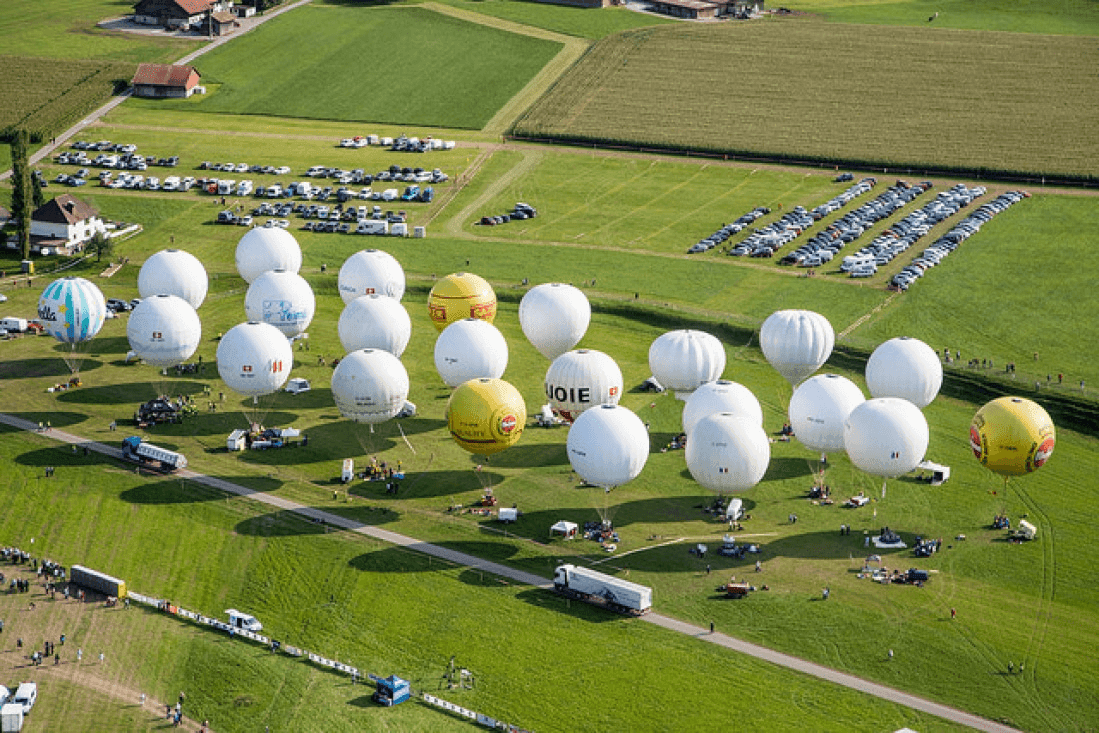
As of 09:10 UTC on August 30, 2026, four teams in the 69th Coupe Aéronautique Gordon Bennett, the world's oldest gas-balloon race, were still airborne over Lithuania, according to the race's own live telemetry feed. One of them was Switzerland's Kurt Frieden and Pascal Witprächtiger, the race's defending champions per the Aero-Club der Schweiz. Their balloon was drifting northeast at 372 meters over the Suwałki Gap, the same unpowered eastward drift that carried a competing Gordon Bennett balloon into Belarusian airspace, and to its downing, in 1995.
Four teams were still over Lithuania as the data was pulled
The map above tracks the race live. At the moment this brief was written, Switzerland's SUI-1 (Kurt Frieden, Pascal Witprächtiger) held position near 54.35°N, 23.19°E at 372 m and was heading northeast at roughly 27 km/h. Germany's GER-2 (Benedict Munz, Matthias Schlegel) was higher, at 1,408 m over the same stretch. France's FRA-3 (Hervé Moine, Justine Legigan) and Spain's ESP-1 (Angel Aguirre, Anulfo González) were also still flying, both above 400 m.
Three other teams, Germany's GER-1, Poland's POL-2, and Switzerland's SUI-3, had already landed nearby, in the same corner of Poland and Lithuania the flying teams had just crossed. Lithuania's own team, LTU-1 (Robertas Komža, Romanas Mikelevičius), had come down a day earlier near Włocławek, Poland, well short of home territory.
None of that is unusual for the race. Gordon Bennett gas balloons are unpowered: pilots control altitude by venting gas or dropping ballast, not direction. The winner is whoever's balloon covers the greatest straight-line distance from the launch site before landing, whether the flight takes hours or days, and wherever the wind happens to carry it.
The 69th edition launched from Gladbeck, Germany, on August 28, 2026. There is no fixed finish line: each team's race ends wherever and whenever its balloon comes down, and every flight must be on the ground by the time the window closes on 5 September. Whether a balloon ends up over Lithuania, out over open water, or in the next country over is the wind's choice, not the pilots'.
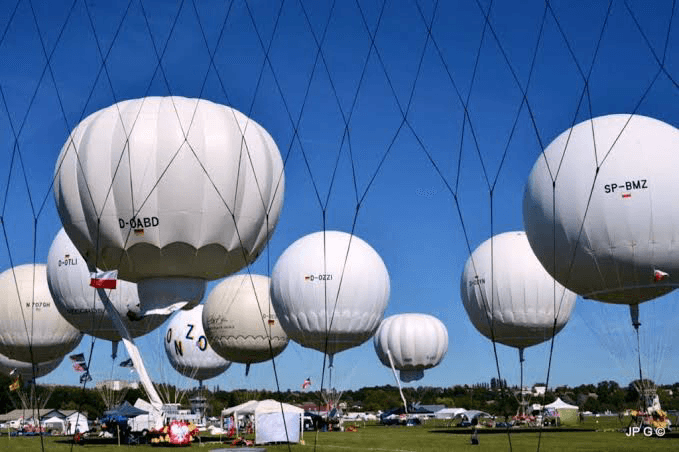
The same general direction killed two racers in 1995
Gas balloons drifting east into airspace beyond NATO's border are not new to this race, and neither is the risk of ending up farther from safety than a pilot intends. In the 39th Coupe Aéronautique Gordon Bennett, launched from Wil, Switzerland, three competing balloons crossed into Belarusian airspace on 12 September 1995, hundreds of kilometers south of this week's Lithuania crossing, near Brest rather than the Suwałki Gap. A Belarusian Air Force Mi-24 helicopter intercepted one of them, the D-Caribbean. Its pilots were Alan Fraenckel, 55, an American, and John Stuart-Jervis, 67, an Englishman, both racing under the U.S. Virgin Islands flag.
According to The Atavist Magazine's reconstruction of the crash, the helicopter's gunner fired three machine-gun bursts, then a final burst that ignited the balloon's hydrogen envelope. The balloon fell roughly 9,000 feet and crashed near Biaroza. Both pilots were killed.
The other two balloons landed or were forced down safely, and their crews were fined for entering Belarus without visas, then released, Wikipedia's account of the race notes.
Race organizers had notified the Belarusian government of the event in May 1995 and filed flight plans for all competing balloons on 9 September 1995, the same day the race launched from Wil, Switzerland, three days before the shootdown. According to the Belarusian air-traffic authority's own later account, shift staff discarded those flight plans because gas balloons, unlike powered aircraft, couldn't specify a landing field in advance, and no Belarusian agency kept a record of the original clearance requests. The Belarusian Air Force commander at the time, General Valery Kostenko, ordered the balloon destroyed after concluding it was an unidentified object over restricted military airspace.
Belarus's 1996 commission report blamed the notification breakdown on BCOAT and Air Defense staff, but also controversially suggested the pilots shared responsibility for not radioing air traffic control themselves. The International Aeronautical Federation rejected the report's conclusions. Belarus has never apologized or paid compensation, and a memorial stone was erected at the crash site in 1996.
What changed since 1995, and what hasn't
Modern Gordon Bennett teams carry GPS trackers that feed the live map linked above in near-real time, replacing the position reports pilots used to radio in by voice, which is a large part of why this brief can name exact coordinates for balloons still in the air. Race organizers also route entrants around active conflict zones and closed airspace when a flight plan makes that necessary. Belarusian airspace has not hosted a Gordon Bennett balloon since 1995.
What hasn't changed is the physics: once launched, a gas balloon's course is wind, not routing. This week's four Lithuania-transiting teams are drifting northeast, which, unlike the 1995 crossing, points them toward Latvia and Estonia rather than Belarus. That is what the live data shows as of this writing, not a guarantee about where the wind takes them next.
SUI-1 and GER-2 crossed the Suwałki Gap earlier today, the same narrow strip between Kaliningrad and Belarus that AirVeto's own wind analysis already covers, for a different reason: it's where contraband balloons drift into Lithuania from the east. A sporting balloon transiting the gap westbound and a smuggling balloon drifting into it eastbound are unrelated events that happen to share the same 65 kilometers of geography.
Update, August 31, 2026: all 23 teams down, Switzerland's second entry flew farthest
By the evening of 30 August, all 23 teams in the 69th Coupe Aéronautique Gordon Bennett had landed, according to the race's own telemetry, the same feed powering the tracker embedded above. The race is scored by distance from the Gladbeck launch site, and by that measure Switzerland's SUI-2 (Balthasar Wicki, René Erni) flew farthest: roughly 1,550 kilometers. It landed in Finland, well north of every other team's route. That result comes directly from the race's own published landing coordinates, not from an official standings announcement, which had not been published as of this writing.
None of the four teams this brief followed over Lithuania on 30 August won. Switzerland's SUI-1 (Kurt Frieden, Pascal Witprächtiger) came down in Latvia after roughly 1,350 kilometers, fifth-farthest. Spain's ESP-1 (Angel Aguirre, Anulfo González) also landed in Latvia, fourth-farthest at roughly 1,410 kilometers. Germany's GER-2 (Benedict Munz, Matthias Schlegel) and France's FRA-3 (Hervé Moine, Justine Legigan) both came down in Lithuania, well short of the leaders. Lithuania's own team, LTU-1, landed in Poland a day earlier, as this brief already reported, and finished among the shorter flights of the 23.
SUI-2's route differed in kind from the four teams this brief tracked over Lithuania, not just in distance. Per its own telemetry, after crossing Germany it continued north over open water, passing Sweden's Gotland and running along Estonia's coast before crossing the Gulf of Finland to land near Lahti. An unpowered gas balloon has no landing option if conditions turn over open sea, a different exposure than the Suwałki Gap route above, where the risk this brief covers is airspace, not terrain.
More teams threaded the Suwałki Gap than this brief's live snapshot showed. Checked against the race's full telemetry, 12 of the 23 teams crossed the gap at some point during the race, not just the four tracked live on 30 August. All 12 hugged the Kaliningrad edge of the gap, not the center.
Six teams came within a kilometer and a half of Kaliningrad's border, checked against AirVeto's own border-line data, the same lines the map above renders:
- France's FRA-3: closest, roughly 120 meters
- Switzerland's SUI-1 and Austria's AUT-2: within half a kilometer
- Poland's POL-1: within 0.6 kilometers
- Spain's ESP-1 and Germany's GER-2: within 1.3 kilometers
The other six kept wider margins: France's FRA-1 and FRA-2, Poland's POL-3, Belgium's BEL-2, Britain's GBR-1, and Switzerland's SUI-3 ranged from roughly 2.6 to 22.7 kilometers off Kaliningrad's border. All 12 teams kept at least 35 kilometers of clearance from Belarus throughout.
A gas balloon can't steer, only change altitude to catch a different wind layer. For the six teams within a kilometer and a half of Kaliningrad, that meant no way to correct course: had the wind pushed any of them a little further north, the alternative to entering Kaliningrad's airspace was venting gas and landing early.
Race organizers said the same gap caused a separate problem: GPS spoofing and jamming on their live tracker. In a Facebook post explaining the tracking map's zig-zags, straight jumps, and gaps, organizers said spoofed GPS positions produce paths no balloon could fly, while jamming stops the tracker from getting a position at all; both are more common, they said, because the race crosses a current conflict area. Organizers said pilot safety was not affected, since air traffic control uses independent radar data and pilots keep receiving new positions even when a few of them are wrong.
The shortest flight belonged to USA-2 (Noah Forden, Brenda Cowlishaw), who landed near Berlin, roughly 430 kilometers from launch, less than a third of the winning distance.
Sources
- The Atavist Magazine - The Balloon that Fell from the Sky (2025)
- Wikipedia - Gordon Bennett Cup (ballooning)
- Aero-Club der Schweiz - Drei Schweizer Teams starten am Gordon Bennett 2026
- Coupe Aéronautique Gordon Bennett - live race data
- Coupe Aéronautique Gordon Bennett - 2026 race telemetry (landings, takeoffs, launch reference point)
- Coupe Aéronautique Gordon Bennett - Facebook post on GPS spoofing and jamming affecting the live tracker
Last updated: