

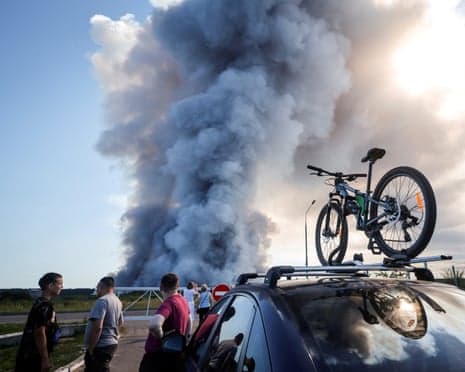
On the night of 17-18 July 2026, Ukrainian long-range drones struck the Wildberries fulfilment centre in Elektrostal, Moscow Oblast (365,000 square metres, roughly 55 kilometres east of central Moscow), destroying the facility and starting a fire whose smoke reached Moscow city limits by Saturday morning. The same overnight operation hit a second Wildberries facility in Kotovsk, Tambov Oblast, and a Nafto-Service oil depot in nearby Noginsk. Zelenskyy confirmed the strikes in a Telegram post: the targeted facilities "were used by the aggressor to supply sanctioned components for the production of drones and navigation equipment," positioning them as military-logistics targets rather than civilian retail.
Wildberries is Russia's dominant e-commerce platform by order volume - often described as Russia's Amazon - with an estimated 90 million registered users. The dual-use claim is reinforced by what the platform was openly selling at the time: body armour, tactical vests, and military load-bearing equipment, items that fall under Russia's active wartime procurement. A search for "бронежилет" (bulletproof vest) on Wildberries returned hundreds of listings marked "tomorrow" delivery to Moscow addresses.

The Elektrostal smoke column drifted 50 kilometres west toward Moscow: the wind field explains why
The fire at Elektrostal generated a smoke plume visible from Moscow city limits by early Saturday morning. Elektrostal lies approximately 55 kilometres east of central Moscow; for smoke to reach the city's eastern edge, it must travel westward across that full distance. Satellite coverage confirmed the plume spread across roughly 2,000 square miles over the Moscow Oblast basin before dispersing.
A smoke column displaced 50 kilometres in a consistent direction is a direct tracer of the low-level wind field: it moves where the wind pushes it. Westward displacement from Elektrostal toward Moscow is consistent with wind blowing west to west-southwest over the basin on the night of 17 to 18 July. This is not an unusual pattern for the Moscow region in mid-July, when high-pressure ridges over western Russia can push wind westward.
AirVeto's wind map covers the Moscow Oblast wind field for the overnight window of 17 to 18 July 2026. The surface and 1,000 m wind layers for this period and location are available on the live map. Wind reconstruction methodology is described in the methodology.
The strike-by-strike record
Ukraine kept hitting Wildberries logistics sites through the rest of July and into August, expanding well beyond the Moscow-Tambov corridor of the first wave. The largest single-night raid, on 20 July, paired 400 UAVs against Moscow Oblast with strikes on three separate fuel and logistics sites near Podolsk. The 22 July wave was the first outside the Moscow-Tambov corridor and the deadliest: Wildberries founder Tatyana Kim confirmed 15 employees injured across Krasnodar and Nevinnomyssk, one fatally.
| Date | Facility | Size | Notes |
|---|---|---|---|
| 18 Jul | Elektrostal, Moscow Oblast | 365,000 m² | Largest fulfilment centre |
| 18 Jul | Kotovsk, Tambov Oblast | - | 1.4M items/day processed |
| 20 Jul | Koledino/Podolsk, Moscow Oblast | 225,000 m² | Largest sorting facility; 400-drone raid |
| 22 Jul | Krasnodar | 150,000 m² | 4th-largest hub; 1 death, 10 injured |
| 22 Jul | Nevinnomyssk, Stavropol Krai | 120,000 m² | 6th-largest hub; 5 injured |
| 23 Jul | Voronezh (Nechayevka) | - | Roof damage, no fire |
| 23-24 Jul | St Petersburg, Novosaratovka, Tver, Simferopol | - | 4 sites in one night; ~50 Pulkovo flights delayed; 3 injured |
| late Jul | Yekaterinburg | - | |
| 29 Jul | Ryazan | - | Hit alongside a Rosneft refinery |
| 30 Jul | Penza | 90,000 m² | 200+ evacuated, 1 injured; 14th facility per United24 Media |
| 30 Jul | Sarapul, Udmurtia | 50,000 m² | 15th facility; no casualties |
| 31 Jul | Volgograd | - | Hit alongside a Lukoil refinery |
| 1-2 Aug | Novosemeykino, Samara | 178,600 m² | "Logistics bridge" to Siberia; no casualties |
Wildberries changed its contract terms before the strikes began - leaving sellers uninsured
A detail that emerged in reporting after the first strikes: in early July 2026, weeks before the Elektrostal attack, Wildberries updated the terms of its standard offer agreement to release the company from liability for goods destroyed or damaged as a result of military actions, drone attacks, shelling, or explosions. The clause was not widely noticed at the time.
Once the fires started, the clause's practical effect became clear: sellers whose inventory was destroyed in Elektrostal, Kotovsk, Podolsk, Krasnodar, and Nevinnomyssk had no contractual claim for compensation. Meduza's reporting, drawing on Russian business sources, estimated the total value of sellers' uncompensated losses at 150 billion rubles; other estimates in Russian media cited figures up to 235 billion rubles. Wildberries offered sellers subsidised loans, delivery deferrals, and logistics discounts - but no direct compensation for destroyed stock. The contract clause had transferred the financial risk of exactly this scenario from the company to its marketplace sellers before the first drone had been launched.
At least 18 strikes, a fifth of the network: what the escalation adds up to
The campaign has not stopped: the Novosemeykino hub, hit 1-2 August, is what Ukraine's Unmanned Systems Forces commander Robert "Madyar" Brovdi called the company's main logistics bridge between European Russia and Siberia. That strike is a useful scale check on the whole campaign. Wildberries operates roughly 200 logistics facilities nationwide, totalling 5.2 million square metres and handling an estimated 45% of Russia's e-commerce market. Ukrainian forces have now struck it at least 18 times in two weeks, disabling more than 1 million square metres - over a fifth of its total floor space, and, per Kyiv Post, ten of its 26 largest distribution centres, several destroyed outright.
The economic damage estimates grew alongside the target list: initial Russian media figures after the Elektrostal fire put losses at 50 billion rubles; the most recent Ukrainian media tallies put direct facility damage at $770 million to $1.2 billion. Sellers' goods losses are counted separately, at 150-235 billion rubles ($1.7-2.7 billion), a cost that lands on marketplace sellers rather than Wildberries itself, per the contract clause above.
Zelenskyy's rationale - that the facilities "supply sanctioned components for the production of drones and navigation equipment" - has remained the public justification throughout. It also fits a wider timeline: on 25 June, Zelenskyy ordered Ukraine's Security Service to run a 40-day "influence operation" against Russia, aimed at "compelling it to end the war" through strikes on oil refineries, military logistics, and the shadow fleet. By 5 July, Ukraine's General Staff was claiming 42.74% of Russian oil refining capacity disabled. The Wildberries strikes, beginning 18 July, fall inside that same window and use the same justification against a target class the original campaign hadn't named. The 40 days run out on 4 August 2026.
The Elektrostal and Kotovsk strikes are among the longest-range large-scale drone operations Ukraine has mounted against Russian logistics. Elektrostal is approximately 500 kilometres from the nearest point on the Ukrainian border; Kotovsk in Tambov Oblast is roughly 700 kilometres from the front lines. Krasnodar and Nevinnomyssk extend the geographic spread further south. For other documented Ukrainian deep-strike operations covered on AirVeto, see the Omsk refinery strike brief and Ukraine's long-range drone campaign, July 2026.